Planamoto
All guides
Guide

Power plugs around the world — voltages, pin layouts and what adapters to pack

Phones, GPS units, intercoms, e-bike batteries, laptops — every multi-country tour leaves a trail of devices looking for a socket. The plug fit is rarely the problem; the voltage and frequency are. This is a practical reference to the plug types riders and cyclists actually meet on a tour, plus what to pack so the only thing that fails in your hotel is the Wi-Fi.

The plug types you'll actually meet

The IEC technically defines 14 plug types (A–O). For touring purposes you'll meet maybe nine. The rest you can ignore — your universal adapter has them anyway.

Type A — North American flat blades

120V, 60Hz

Pins: Two parallel flat blades, ungrounded. One blade slightly wider than the other on modern plugs (polarised).

Where: USA, Canada, Mexico, most of Central America, parts of South America (Colombia, Venezuela, Ecuador), Japan (Japan-only at 100V/50Hz or 60Hz depending on region).

Often interchangeable with Type B sockets. Older sockets accept Type A only; modern ones accept both.

Type B — North American grounded

120V, 60Hz

Pins: Two flat blades plus a round earth pin below, forming a 'face' shape. Earth pin protrudes ~3mm beyond the blades so it makes contact first.

Where: USA, Canada, Mexico, Japan (rarer than Type A), and increasingly common in Central America for high-draw appliances.

All laptop chargers and most modern electronics use Type B. A Type A travel adapter often won't fit a Type B brick.

Type C — Europlug

220–240V, 50Hz

Pins: Two round 4mm pins, 19mm apart, ungrounded. Rated max 2.5A — the small thin plug you see on phone chargers and lamps.

Where: Nearly all of continental Europe, plus parts of South America, Asia, Russia and the Middle East. Almost universally accepted as a 'fits in any European socket' standard for low-draw devices.

Type C plugs fit into Type E, F, J, K, L and N sockets. The thing every European phone charger has by default.

Type F — Schuko

230V, 50Hz

Pins: Two round 4.8mm pins, 19mm apart, with earth contacts as clips on the top and bottom edges. Plug is recessed into the socket.

Where: Germany, Austria, Netherlands, Sweden, Norway, Finland, Spain, Portugal, Greece, Russia, Turkey, most of Eastern Europe.

Functionally the European standard for any device that draws more than ~2.5A. A Type C plug fits a Type F socket; a Type F plug doesn't fit a Type C socket.

Type G — British 13A

230V, 50Hz

Pins: Three rectangular flat pins in a triangle: live and neutral on the bottom, longer earth pin on top. Plug includes a replaceable fuse (usually 3A or 13A).

Where: UK, Ireland, Malta, Cyprus, Hong Kong, Singapore, Malaysia, Gibraltar, the UAE (alongside Type C/F).

The chunkiest and arguably safest domestic plug in the world. The earth pin opens shutters over live and neutral — kids can't poke things in.

Type I — Australian / Chinese

230V, 50Hz (Australia / NZ); 220V, 50Hz (China); 220V, 50Hz (Argentina, reversed pins)

Pins: Two flat pins at an angle (inverted V), plus a vertical flat earth pin below. Looks like an angry face.

Where: Australia, New Zealand, China, Argentina (Argentina reverses live and neutral). Fiji and PNG also use it.

Australia, NZ and China use the same plug shape — but Australian appliances are NOT certified for use in China and vice versa, because the safety/compliance regimes differ.

Type J — Swiss

230V, 50Hz

Pins: Three round 4mm pins in a wide offset triangle — two close together for live/neutral, earth pin sits ~5mm to the side and is offset from centre.

Where: Switzerland, Liechtenstein, Rwanda, the Maldives (alongside Type D/G).

Almost-but-not-quite a Type C — a Type C plug fits a Type J socket, but a Type J plug won't fit anything else in Europe. Switzerland is the one alpine country where you'll want a proper adapter.

Type L — Italian

230V, 50Hz

Pins: Three round pins in a horizontal line, earth in the middle. Comes in 10A (small, 4mm pins) and 16A (large, 5mm pins) variants — they're not interchangeable.

Where: Italy, Chile, Uruguay, parts of North Africa (Libya, Ethiopia).

Modern Italian buildings increasingly use 'Schuko-compatible' sockets that accept Type C, F, and L. Older buildings have Type L only. Hotels almost always have both.

Type N — Brazilian

127V or 220V, 60Hz

Pins: Three round pins in a triangle — two for live/neutral (4mm), earth pin in the middle and slightly higher. Almost identical to Type J but with the pins closer together.

Where: Brazil, South Africa (newer installations).

Brazil is split — north and northeast typically 127V, south typically 220V. Check the socket label at the hotel. A dual-voltage charger handles both; a kettle or hairdryer doesn't.
By region — what to expect

North America (US, Canada, Mexico)

Types A and B. 120V at 60Hz. Bring a UK→US adapter and check every device for '100–240V' on the brick. A British kettle plugged in via adapter to 120V will boil at quarter speed but still work. A British hairdryer often won't power on. Power strips with USB ports are universal in airports and hotels.

Western Europe (France, Germany, Spain, Netherlands…)

Types C and F. 230V at 50Hz. UK plugs need an adapter (UK→EU 'tourist' adapter, the cheap ones are everywhere in airports). A Schuko-style adapter is better than a Europlug-only one for higher-draw devices like laptops. France, Belgium, Czechia, Slovakia and Poland also use Type E sockets which take both C and F plugs.

UK and Ireland

Type G. 230V at 50Hz. The chunky three-pin with the fuse. If you're coming from Europe, a Schuko→UK adapter is essential and absurdly bulky. Universal adapters with a built-in fuse (e.g. SKROSS, Mu Lite) are worth the extra money.

Switzerland

Type J. 230V at 50Hz. Looks like a Type C but with an offset earth — a standard EU plug won't fit a Type J socket. Hotels often have at least one universal socket, but if you're staying in alpine refuges, pack a UK→Swiss or EU→Swiss adapter.

Italy

Type L (and increasingly Type F). 230V at 50Hz. Modern hotels have hybrid sockets that take C/F/L. Older hotels and apartments may be Type L only. The Italian 10A and 16A variants of Type L are NOT interchangeable — the 16A is for ovens and air-con, not chargers.

Australia & New Zealand

Type I. 230V at 50Hz (Australia) / 230V at 50Hz (NZ). Same plug as China but the appliances aren't legally interchangeable. Sockets often have a built-in switch — flip it on or your charger does nothing.

Japan

Types A and B. 100V — the lowest standard voltage in the world. Frequency splits east/west: 50Hz in Tokyo and the north, 60Hz in Osaka and the south. Most modern electronics tolerate both, but anything with a motor (electric razor, certain old hairdryers) might run wrong-speed on the 'other' side of the country.

Brazil

Type N. Voltage is the trap: 127V in the north and northeast (Rio, Salvador, Recife, most of the Amazon), 220V in the south (São Paulo down to Argentina). Each socket should be labelled — read it. Mid-tier hotels often have both.

What to actually pack

For European-only tours, one UK→Schuko (or vice versa) adapter does the job. For anything further afield, a single universal adapter saves the day.

Universal travel adapter

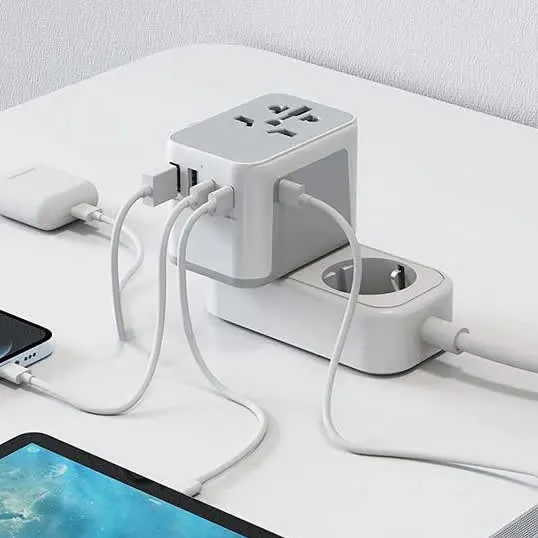
Mu Lite (sliding-pin design, pocket-sized) or Mogics Donut (built-in USB ports and a small ring of outlets) are the two cult picks. Avoid the cheapest Amazon adapters — counterfeits are common and the live pin can slip back into the body. Spend £20–30 once.

USB-C PD wall brick

65W minimum if you charge a laptop, 30W if you only do phones and intercoms. A single GaN brick (Anker 736, UGREEN Nexode 65W) covers everything from a phone to a MacBook Pro. Use the local socket via your travel adapter.

Bike-side 12V → USB

A hardwired 12V→USB-C charger on the bike (Quad Lock dual-port, SAE-to-USB pigtail off the battery) keeps phones, GPS units and Bluetooth intercoms topped up while you ride. Most touring kit never sees a wall socket — only the hotel evening does.

What to leave at home

Hairdryers, kettles, electric razors that aren't dual-voltage. Anything labelled '120V only' on the brick will buzz, smoke or pop a fuse on European 230V. Anything labelled '230V only' will run at a quarter-power on US 120V. Read the small print on the brick before packing.

Voltage vs frequency — the actual risk

The brick label

Look on the small text of any charger: '100–240V, 50/60Hz' means it works everywhere. '230V, 50Hz only' means do NOT plug into a US socket. '120V, 60Hz only' means do NOT plug into a European socket. Almost every modern phone, laptop, camera and bike-comms charger is dual-voltage. Almost no kitchen appliance is.

Why frequency rarely matters

50Hz vs 60Hz only matters for AC motors (older fans, some electric razors, mechanical clocks) and certain transformers. Modern switched-mode power supplies — anything with a small black brick on the cable — don't care. The brand-new e-bike charger or laptop PSU just sees DC after rectification.

What a step-up/step-down converter is

A heavy box that converts 120V→230V or 230V→120V. Required if you're insistent on bringing a 120V kettle to Europe. Heavy, expensive, often poor quality. Almost always cheaper to buy the equivalent appliance at the destination.

Plan the route too

Once the kit is sorted, the route is the fun part. Browse our hand-curated multi-day tours and clone one as your starting point.

Browse tours
Planamoto uses essential cookies and local storage to keep you signed in and to remember your preferences. See our Privacy Policy for details.